
Cast Iron Drains
Cast Iron Drain Replacement in Dallas–Fort Worth
Cast iron drains were built to last about a lifetime. Across much of Dallas, that lifetime is up. When the pipe under the slab has rusted through, we replace it.
- Price before work starts
- Your approval before anything begins
- Tested before we leave
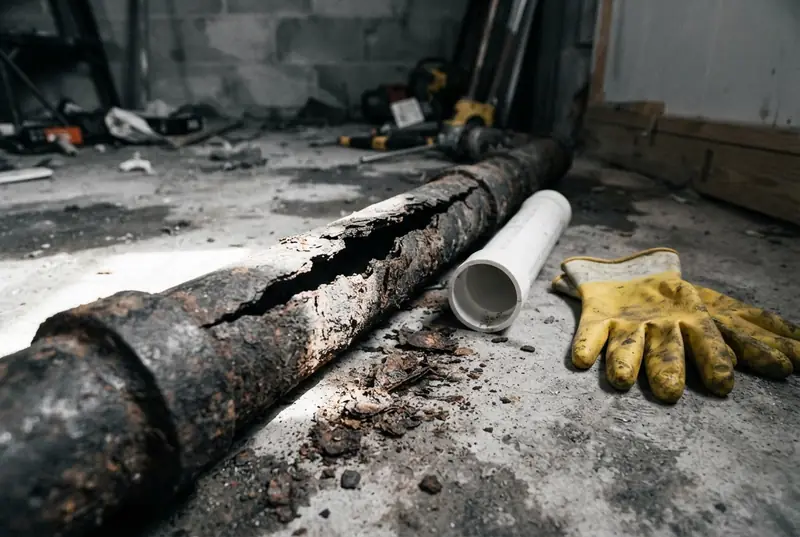
Cast Iron Drains: what you're dealing with
Until about the 1980s, the drains under a Texas slab were cast iron. It is strong pipe, but it rusts from the inside. Sewer gas eats at the top of the pipe. Decades of wastewater wear a channel through the bottom. Scale builds on the walls and snags everything that passes. Eventually the pipe cracks, the bottom drops out, and wastewater starts draining into the soil under your house.
You can't see any of that from above. So the job starts with proof: a camera through the lines and a hydrostatic test, which fills the drain system with water to floor level and shows whether it holds. If the level drops, sections are isolated one at a time until the leaking runs are found. Then the bad pipe is replaced with PVC, usually by tunneling under the slab from outside so the floors stay in one piece.
When to suspect the cast iron
- Backups and slow drains that return no matter how often the line is cleaned
- Sewer smell inside the house, especially around bathrooms
- A drain cable that keeps coming back with rust flakes and black scale
- New floor cracks or foundation movement near a bathroom or kitchen
- A house built before the 1980s whose drains have never been inspected
The job
How the work runs
Camera and test
A camera goes through the drains and a hydrostatic test shows whether the system holds water. Leaking sections are isolated and mapped.
Scope and price
You see where the pipe has failed and get the price for replacing those runs, or the whole system if that is what the testing shows.
Tunnel and replace
Access tunnels are dug under the slab from outside. The cast iron comes out and PVC goes in, supported and sloped to drain.
Retest and backfill
The new drains are tested again, and inspected where the city requires it. Only then are the tunnels packed back in and the site cleaned up.
North Texas
Why it happens here
Dallas and its older suburbs are full of 1950s, 60s and 70s houses, and most of them went in with cast iron under the slab. That pipe is now fifty to seventy years old. The clay works against it too: a leaking drain keeps the ground under one part of the house wet, the clay swells there, and the slab starts to move. That is why a hydrostatic test has become a routine request when an older home in this area changes hands.
Straight answers
Cast Iron Drains: common questions
What is a hydrostatic test?
It is a leak test for the drains under your house. The line is plugged at the cleanout, the system is filled with water up to floor level, and the level is watched. If it holds, the drains under the slab are tight. If it drops, something down there is leaking, and further testing finds which sections.
Can failing cast iron be patched instead of replaced?
One crack in otherwise solid pipe can be repaired. Pipe that is thin and scaled from end to end can't. Fix one spot on worn-out cast iron and the next weak spot becomes the new leak. The camera shows which situation you're in.
Do my floors have to come up?
Usually not. Tunneling under the slab from outside reaches the pipe without touching the flooring, and most of the mess stays in the yard. Going through the floor only makes sense for a short run that is easy to reach, or when a room is already torn out for a remodel.
Service area
Cast Iron Drains across DFW
The same work, in every city on the list.