
Slab Leaks
Slab Leak Repair in Dallas–Fort Worth
A leak under the slab doesn't announce itself. It shows up as a warm floor, a high bill or a meter that never stops. We find the line that failed and lay out every way to fix it.
- Price before work starts
- Your approval before anything begins
- Tested before we leave
Slab Leaks: what you're dealing with
Most homes in Dallas–Fort Worth sit on a concrete slab with the water lines buried underneath. For decades those lines were soft copper. Copper under a slab corrodes, wears thin where it rubs against concrete as the foundation moves, and eventually opens a pinhole. Hot lines usually go first, because they expand and contract every time someone runs a tap.
A slab leak never heals and never stays small. It washes soil out from under the foundation, soaks the flooring and runs up the bill every hour it is left alone. You have three ways out. Break through the floor and fix that one spot. Dig a tunnel in from the yard and fix it from below. Or cut the bad line out of service and run a new one overhead, through the attic and walls. Location decides a lot of it. So does history: a pipe that has leaked twice is not done leaking.
How a slab leak shows itself
- A spot on the floor that is warm to bare feet, whether it is tile, wood or bare concrete
- The water meter keeps moving with every fixture shut off
- Water you can hear moving under the floor once the house goes quiet
- Damp carpet, cupped wood flooring or wet baseboards with no source in sight
- A water heater that never seems to rest, or a bill that climbs every month
The job
How the work runs
Confirm it
The meter is read with everything off. Then hot and cold each get their own pressure test, which shows whether the leak is under the slab and which line has it.
Pinpoint it
The leak is tracked down by sound and by tracing the line, so any opening is small and in the right place.
Choose the fix
Through the floor, under it or around it. Each option comes with its price and how much of the house it disturbs. You decide.
Fix it and prove it
The repair is made, then the hot and cold sides go back under pressure. Concrete and flooring wait until the gauge holds.
North Texas
Why it happens here
Blame the dirt. North Texas is built on expansive clay, which heaves after a wet spring and pulls away from the foundation by late August. The slab rides that cycle every year, and the copper under it gets flexed and scuffed the whole time. In much of the country a slab leak is a rarity. Here it is a routine job. One more thing worth knowing: if your foundation has been lifted or had piers installed, have the plumbing under it tested afterward. Leveling a slab can crack the pipes below it.
Straight answers
Slab Leaks: common questions
How can I tell if the leak is on the hot side or the cold side?
Shut off every fixture and watch the water meter. If it is moving, shut the cold inlet valve at the water heater. A meter that stops points to the hot side. A meter that keeps turning points to the cold side. A pressure test confirms it either way.
Will you have to jackhammer my floor?
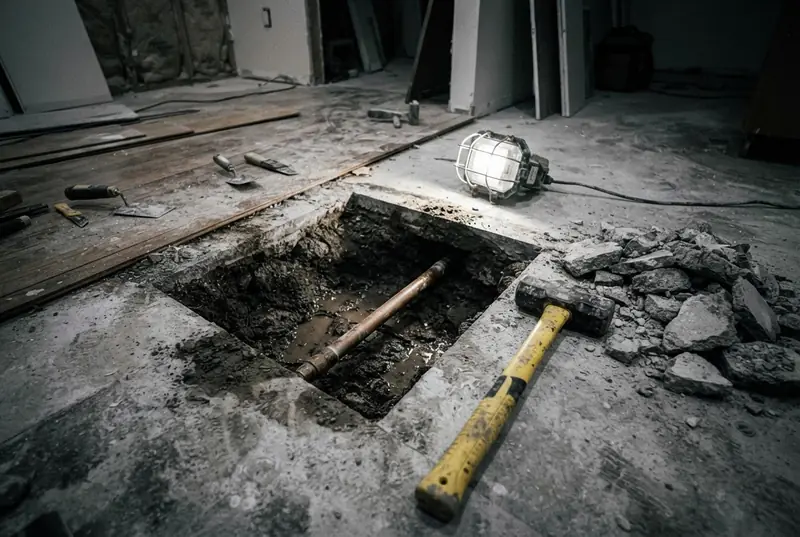
Not always. A leak near an outside wall can often be reached by tunneling under the slab from the yard. A line that has leaked before is usually better abandoned and rerouted overhead, which leaves the floor alone. Opening the slab makes sense when the leak is easy to reach and the rest of the pipe is still in good shape. If it isn't, the conversation turns to a repipe.
Can a slab leak wait a few weeks?
It shouldn't. Every day it runs, the water undermines more of the soil under the foundation and soaks more of whatever sits above it. If the repair can't happen yet, shut the water off at the main whenever you aren't using it. That limits the damage until the line is fixed.
Service area
Slab Leaks across DFW
The same work, in every city on the list.