
Sewer Lines
Sewer Line Repair & Replacement in Dallas–Fort Worth
Every drain in the house runs to one pipe. When that pipe breaks, nothing else works until it's fixed. We put a camera in it, find the break and fix what is actually wrong.
- Price before work starts
- Your approval before anything begins
- Tested before we leave
Sewer Lines: what you're dealing with
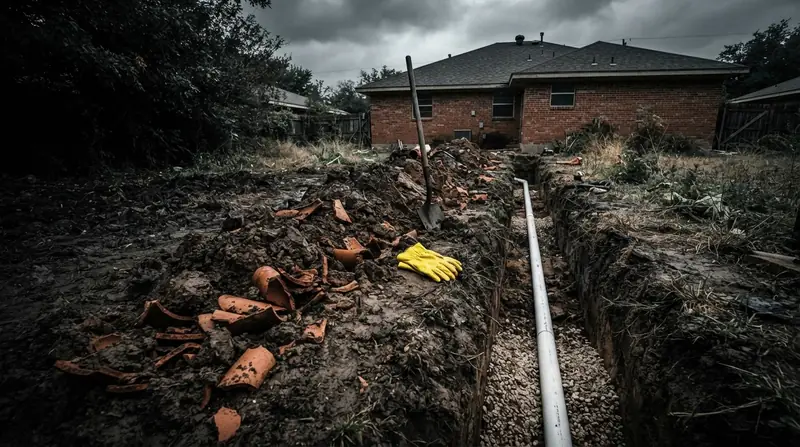
One buried pipe takes everything the house sends down a drain and carries it to the city main. Under a lot of Dallas-area homes, that pipe has been in the ground for fifty years or more. The old ones are clay or cast iron. Clay cracks and pulls apart at the joints. Cast iron rusts through from the inside. Roots find every gap, and shifting soil leaves low spots where waste sits instead of flowing.
Cleaning a broken line buys time. It doesn't fix the pipe. That is why a sewer repair here never gets a price before it gets a camera. The footage shows what broke, where, how deep, and whether the job is one bad section, a longer run or the whole line. If the trouble turns out to be under the house rather than out in the yard, that is cast iron drain work.
Signs the sewer line is the problem
- The lowest drains in the house back up first: a tub, a shower, a floor drain
- Several fixtures drain slowly at the same time
- Toilets bubble or gurgle when water drains somewhere else in the house
- Sewage smell in the yard, or one stripe of grass that is always wet and greener than the rest
- The line was cleaned and the clog came back within weeks
The job
How the work runs
Put a camera in it
The camera goes in at the cleanout and runs to the city connection. If the house has no cleanout, you hear the options for getting access.
Mark it and price it
The damage is located and its depth marked on the ground. Digging waits until you have the repair price in hand.
Dig and replace
Buried utilities are located first. Then the bad pipe comes out and new pipe goes in on firm bedding at the right slope.
Test, then backfill
Water is run through the new line and checked before the trench is closed. The yard is graded back and the site is left clean.
North Texas
Why it happens here
Two things wreck sewer lines in North Texas: the dirt and the trees. Rain makes the clay swell. A dry summer shrinks it back. That yearly movement pulls joints apart and leaves sags in the line. Roots go where the water is, and a leaking sewer joint is the most dependable water in the yard in a dry August. If the house predates the 1970s, assume clay or cast iron in the yard until a camera says otherwise.
Straight answers
Sewer Lines: common questions
Is a broken sewer line my problem or the city's?
The part on your property is yours. The usual rule across North Texas: the sewer line belongs to the homeowner from the house out to the city's connection, and so does its repair. The main is the city's. Exactly where the handoff happens varies by city, so ask your water utility where its part starts.
Do you have to replace the whole line?
No. If the camera shows one failed section with sound pipe on both sides, a spot repair is the right job. If the line is cracked, sagging or root-bound along its length, patching one spot just moves the next backup a few feet. The footage decides it.
What is a belly, and can cleaning fix it?
A belly is a low spot where the pipe has sagged. Water slows down there and solids settle out. Jetting clears what has collected, but the sag stays, so it fills again. The fix is to dig up that section and relay it at the correct slope.
Service area
Sewer Lines across DFW
The same work, in every city on the list.